Wednesday, 11 November 2026
The last 24 hours' hottest news in AI, sorted by field, each story with a line on why it matters.
Story of the day
The single most consequential story of the day.
- Class A shares in the proposed sale
- 825,000,000
- low end of the expected price
- $70.00
- high end of the expected price
- $78.00
- Nasdaq symbol it has applied for
- ANT
Anthropic opens the roadshow for its IPO
Anthropic has started the roadshow for a proposed sale of 825,000,000 Class A shares, at an expected $70.00 to $78.00 each. It has applied to list on the Nasdaq Global Select Market under the symbol ANT. The registration statement is not yet effective.
Why it's the story of the dayA frontier lab is asking public investors to put a price on Claude's maker.
Startup of the day
A young company people are talking about today.
Graphon raises $35 million for agent memory
The 20-person San Francisco company raised a Series A led by RRE Ventures, taking total funding to $43.3 million. It says its graph memory scored 93.9% on LoCoMo and used 58% fewer tokens than loading the whole conversation.
Why it's worth a lookThe round is for a memory an agent can point at, not for another chat window.
The Next Web ↗Models & labs
New models, the labs behind them, and the rules they answer to.
Anthropic opens the roadshow for its IPO
The proposed sale is 825,000,000 Class A shares, 801,351,354 of them from Anthropic and 23,648,646 from existing holders. Underwriters may buy up to 123,750,000 more shares for 30 days. The registration is not yet effective.
Why it mattersA frontier lab is asking public investors to put a price on it.
Anthropic ↗Gemini 4 Carbon opens to paying users
Google made Gemini 4 Carbon available to paying developers and businesses, and it is rolling out to Google AI Ultra subscribers. The introductory price matches Argon, at $2 per million input tokens and $10 per million output tokens, through 30 November.
Why it mattersThe model Google had limited to cyber defenders is now a public API.
Google ↗Amazon releases Mitra-v2 for tables
Amazon Science released Mitra-v2, a tabular model pretrained only on synthetic tables, under Apache-2.0 on Hugging Face. On TabArena's 51 datasets it leads the single-model field, and it finishes all 51 inside the one-hour budget.
Why it mattersA new table can be scored without training a fresh model for that table.
Amazon Science ↗Meituan posts LongCat-2.5 weights
The LongCat-2.5 card describes a multimodal mixture-of-experts model with 1.6 trillion parameters and about 48 billion active per token. The weights are under the MIT licence, and a W4A4 path quantises expert weights and activations to 4 bits.
Why it mattersA trillion-parameter model can be downloaded and used commercially.
Hugging Face ↗llama.cpp reads Kimi K3.1 vision
Build b12259, tagged 10 November, adds vision support for Kimi K3.1 and fixes preprocessing for both K2.5 and K3.1. The projector MLP is renamed along the way.
Why it mattersA local runner can take images from another Kimi checkpoint.
GitHub ↗Ollama's preview generates on MLX in parallel
Preview 0.40.17, tagged 10 November, allows concurrent generation in the MLX backend and memory-maps weights for Vulkan integrated GPUs. It also bumps the bundled llama.cpp to build b12257.
Why it mattersA Mac can hold more than one local generation at a time.
GitHub ↗Anthropic's SDK adds Claude Tag metrics
Python SDK 2.8.0, tagged 10 November, adds Claude Tag metrics to analytics summaries and user reports, and a reply mode for Claude Tag Slack channels. On Bedrock it refuses a model ID whose part before the first semicolon is empty, a dot or two dots.
Why it mattersA usage report can now include the tag a team attached to the call.
GitHub ↗A paper finds heads that pick a modality
A 9 November paper says that when an image and the text disagree, a small set of attention heads decides which one the model follows. The authors call them arbitration heads and use them to steer that choice at inference.
Why it mattersA multimodal mistake may sit in a few heads, not in the whole network.
arXiv ↗A paper asks where representations line up
A 9 November paper revisits the claim that capable language models grow closer to vision models in representation space. It says newer models and the similarity metrics themselves put that trend in doubt.
Why it mattersA shared 'platonic' space is a claim that still needs a measurement.
arXiv ↗$132.5 billion
CoreWeave said that was its revenue backlog on 30 September.
Third-quarter revenue was $3,661 million. CoreWeave ↗
Agents & coding
AI that acts on its own, and the tools developers build with.
ChatGPT lets a business answer for itself
OpenAI opened Businesses in ChatGPT in beta. A firm can claim a profile, and eligible US shops can launch a Business Agent whose chat is labelled and kept apart from the customer's own thread. OpenAI says 1.2 billion people use ChatGPT each week.
Why it mattersA shopper can ask the company, not only the assistant, what it sells.
OpenAI ↗Claude can join the meeting and start the work
TechCrunch said Claude Meetings joins a video call as a visible participant and can draft the plan being discussed while people are still talking. It launches in beta on Team and Enterprise plans and works with Google Meet at the start.
Why it mattersThe notes and the first draft can exist before the call ends.
TechCrunch ↗Muse arrives on the watch
TechCrunch said Meta's Muse agent now runs on Apple Watch and Wear OS, by voice, text or dictation. Meta announced it on Monday. The same piece says Muse was one of 12 mobile apps to pass 10 million US downloads in its first 40 days.
Why it mattersAn always-on assistant is now a thing you wear, not only an app.
TechCrunch ↗Claude Code's fast mode reaches Vertex
Claude Code 2.1.322, tagged 10 November, adds fast mode on Vertex in the global, US and EU regions. If Vertex refuses the fast request, the session falls back to standard speed.
Why it mattersA team on Google's cloud can try the quicker Claude path without a new install.
GitHub ↗LangChain keeps middleware calls off the stream
LangChain 1.4.10, tagged 10 November, stops model calls that middleware makes internally from appearing on the messages stream. It also leaves trace inputs out of ModelRefusalMiddleware.
Why it mattersA chat UI no longer has to show the model's private side calls.
GitHub ↗browser-use 1.0.1 brings its own Chromium
Release 1.0.1, tagged 10 November, lets the command-line agent install Chromium when no Chrome is present, including on servers and in CI. An allowed-domains rule can no longer be bypassed through a cloud browser.
Why it mattersA browser agent can run where the machine has no Chrome installed.
GitHub ↗OpenAI's Python SDK types async function tools
Python SDK 3.49.0, tagged 10 November, adds typed async function tools. It also encodes microphone recordings as valid PCM WAV, fixing a bug in how those files were written.
Why it mattersAn agent tool can be declared in types, and a recorded clip is a real WAV.
GitHub ↗A benchmark scores how agents organise the work
WorkflowArena, posted 9 November, tests multi-agent systems that invent the workflow at run time, including spawning worker agents. The authors say the quality of that organisation is now part of the result.
Why it mattersA harness that lets the model design the team needs a test for the design.
arXiv ↗A memory store interleaves two kinds of evidence
HiVe-Mem, posted 9 November, alternates widening the memory a multimodal agent can search with composing the evidence a query actually needs. The authors say semantic search over compressed memories misses both.
Why it mattersA long-running agent needs more than one way to look up its past.
arXiv ↗Tool of the day
Something you can try in the next five minutes.
browser-use 1.0.1
The patch lets a command-line agent install its own Chromium when Chrome is missing, including on a server or in CI. An allowed-domains rule can no longer be skipped by sending the session to a cloud browser.
Video generation
The models and tools that make video.
SwitchX 3.0 relights a shot and keeps the actor
Beeble's SwitchX 3.0, announced 10 November, is a video-to-video model rebuilt on MiniMax H3. It takes up to four references, moves the background, and locks the actor inside the alpha. Output is 4K and 10-bit.
Why it mattersA location change can leave the actor's pixels where they were shot.
Beeble ↗Firefly can cut a vlog and hold the brand
Adobe's Firefly update on 10 November can arrange travel clips, add captions and generate b-roll, and set brand colours once so they carry across projects. Always-on agents, which can organise footage in the background, are planned for beta in early 2027.
Why it mattersA video draft can start from the camera roll, with the brand rules already set.
Adobe ↗DeepBrain's agent builds a video from a chat
AI Studios 5.0 can start from a line, a script or a document and have Video Agent write the script, build the scenes and add a voice. From 10 November one credit balance covers export, dubbing and generation. Personal is $29 a month for 700 credits.
Why it mattersA finished clip can start from a sentence instead of a timeline.
DeepBrain AI ↗ComfyUI 0.45 adds Pika's video and sound nodes
ComfyUI 0.45.0, tagged 10 November, adds partner nodes for Pika H3 Flex and for Pika soundtrack, sound effects and music. It also makes the SeedVR2 VAE slice length follow free memory, and turns local web sign-on on by default.
Why it mattersA node graph can call a hosted video model and a music model in one workflow.
GitHub ↗A 2B video model runs in the browser
Fusor Labs published Motif-Video-2B compiled for the browser, split into a text bundle and a video bundle because one WebAssembly memory holds at most 4 GiB. The weights are Apache-2.0 and load only in the motif-video-wasm runtime.
Why it mattersA short clip can be rendered on the device, without a PyTorch install.
Hugging Face ↗An experiment mixes two MiniMax-H3 branches
A community checkpoint splices MiniMax-H3 so blocks 0–24 and 50 onward come from FL2VA and blocks 25–49 from REF2VA. The card says the BF16 file is about 37.46 GiB and every checked tensor matched. It is not an official MiniMax release.
Why it mattersA hybrid can be tested as one file instead of two branches.
Hugging Face ↗A paper asks what breaks v-prediction
A 9 November paper looks at pixel-space flow matching and why the usual v-prediction objective is hard to train. It uses a patch-wise view of the noise to argue the trouble is off the data manifold.
Why it mattersTraining video or image models in pixel space still has a loss that misbehaves.
arXiv ↗Sparse clicks can correct a 3D reconstruction
Click3R, posted 9 November, lets a person correct a feed-forward 3D model with a few correspondence clicks on an image pair. The authors say those models otherwise give one prediction and no way to fix it.
Why it mattersA bad 3D guess can be steered without rerunning the whole model.
arXiv ↗A paper tracks how action training shifts a video model
SWAM, posted 9 November, studies world-action models that predict video and actions together. The authors say teaching the model actions can damage the language-video alignment it learned first.
Why it mattersA robot video model can get worse at following words as it learns to move.
arXiv ↗Register a frontier model in New York
New York opened a portal on Tuesday. Developers with more than $500 million in annual revenue must register by 1 January 2027, publish a safety framework, and report critical incidents within 72 hours.
If you ship a frontier model and clear that revenue line, start the registration before the year turns. TechCrunch ↗
Creator tools
The apps and platforms people make video with.
Claude Sheets and Whiteboards open in beta
Anthropic put Claude Sheets and Whiteboards in beta on paid plans, and made Claude Data generally available. Sheets can build tabs, formulas and drop-downs and export to .xlsx or CSV. On Enterprise, Data turns on by default on 19 November.
Why it mattersA spreadsheet can stay inside the chat instead of being pasted out.
Anthropic ↗Adobe opens its apps to other chatbots
TechCrunch said Adobe, at MAX in Miami, is shipping a local MCP server so ChatGPT, Claude or Gemini can call Creative Cloud. Photoshop gains relighting and style sliders. Premiere gains object removal and a new colour grade.
Why it mattersA chat window can drive the editor instead of the editor growing its own chat.
TechCrunch ↗Wrangler can forward dev-server options
Wrangler 4.160.0, tagged 10 November, lets the experimental cf-wrangler delegate pass options such as --inspector-port, --ip, --var and --persist-to through to the development runtime. Invalid options are still rejected.
Why it mattersA Cloudflare dev session can take the flags a local debugger already expects.
GitHub ↗The AI SDK can queue a chat that is still answering
AI SDK 7.0.168, tagged 10 November, adds experimental_queue on useChat so messages sent during a response wait their turn. It also calls the stream onError handler once per invalid tool call, not repeatedly.
Why it mattersA user can type the next message without cancelling the one in flight.
GitHub ↗AI SDK 7.0.169 shrinks its internal checks
AI SDK 7.0.169, also tagged 10 November, uses Zod Mini for internal validation to cut bundle size. The public message schemas keep their classic Zod methods and still work with Zod 3 and Zod 4.
Why it mattersA smaller client bundle does not have to change how messages are typed.
GitHub ↗Cloudflare API calls can take extra headers
workers-auth 0.18.0, tagged 10 November, reads CLOUDFLARE_API_HEADERS as a JSON object and adds those headers to Cloudflare API requests. Body and transport headers stay protected, and values outside a diagnostic allowlist stay redacted in logs.
Why it mattersA proxy or a gateway can stamp its own header without turning logging inside out.
GitHub ↗Vitest can run a Worker's containers
The Cloudflare Vitest plugin 1.7.0, tagged 10 November, builds or pulls container images before tests and gives Durable Objects a real ctx.container. Projects that want the old behaviour set dev.enable_containers to false and skip Docker.
Why it mattersA test can exercise the container binding instead of skipping it.
GitHub ↗OpenHands 1.38 edits a plugin from the help pane
OpenHands 1.38.0, dated 10 November, can edit an executable plugin's configuration from the automation help. The release notes list that with the rest of the 1.38 features.
Why it mattersAn automation's plugin settings can be changed without leaving the help screen.
GitHub ↗Gemini CLI 0.69 previews a usage heatmap
Preview 0.69.0, tagged 10 November, adds a /stats heatmap subcommand for daily token use. It also keeps a literal dollar sign in place when a template replaces placeholders.
Why it mattersA coding CLI can show which days burned tokens, and a price in a prompt stays a price.
GitHub ↗This was a breakout quarter for CoreWeave, with revenue increasing by more than $1 billion sequentially and adjusted operating margins reaching double digits a quarter ahead of plan
Media & entertainment
AI in the films, shows, micro-dramas, music and ads people watch, the studios and platforms making them, and the rules for AI-made content.
Spotify's DJ gets new voices and a quieter mode
Spotify said Premium listeners in existing DJ markets can pick seven new English voices and two new Spanish ones, alongside DJ X. They can also turn off the commentary between songs. Spotify said 80 percent of DJ listeners come back week after week.
Why it mattersThe DJ can play the queue without talking over a room.
Spotify ↗Premiere mobile adds songs from Universal and Warner
Variety said Premiere mobile now includes hundreds of thousands of tracks from Universal and Warner, first in the US, Canada, Australia and New Zealand. Use is personal and non-commercial, and a clip can take up to 60 seconds of a song.
Why it mattersA short video can use a real catalogue track without a separate music deal.
Variety ↗Premiere on the desktop can cut, grade and score
Digital Camera World said Premiere's new assistant can bin footage, build a sequence, sync cameras and grade clips from a prompt. Generative tools can also lay down four audio tracks from the picture.
Why it mattersThe tedious pass on a timeline is the part Adobe is handing to the assistant.
Digital Camera World ↗A ten-person studio is making brand films with AI
Raconteur profiled The Blue Horizon, an AI film studio of about ten people whose commercial work includes a Barbie film for Mattel and a Lynx ad for Unilever. Co-founder Marco said the work still has scripts, storyboards and music the team produces.
Why it mattersA brand spot from a small AI shop still has a crew, not only a prompt.
Raconteur ↗A voice shop clones actors who consent and get paid
On a 7 November podcast, Dan Price, founder of Bionic VO and president of Oink Ink Radio, described a platform that clones professional actors only with consent and pays them when the voice is used. The episode is Marketing in the Age of AI.
Why it mattersAn ad voice can be synthetic and still belong to a person who agreed.
Marketing in the Age of AI ↗Claude can turn a deck into a one-minute explainer
The Verge said Anthropic's new office tools can turn a presentation into a one-minute explainer. Meetings, Sheets and Whiteboards are in beta. Sheets and Whiteboards are on paid plans, and Meetings is on Team and Enterprise.
Why it mattersA slide deck can leave the meeting as a short video, not only as notes.
The Verge ↗A paper distils visual agents with a second teacher
Reframe, posted 9 November, is a post-training method for visual agents that use tools. It tries to stop the model ignoring what a tool just returned, and to keep a bad action from starving the next distillation step of evidence.
Why it mattersAn agent that can see still has to be taught to look at the tool's answer.
arXiv ↗Chips & compute
Chips, data centres and the power behind them.
CoreWeave's quarter passed $3.6 billion
CoreWeave reported third-quarter revenue of $3,661 million and a backlog of about $132.5 billion as of 30 September. It raised 2026 revenue guidance to $13.0 billion to $13.3 billion. Active power is over 1.7 gigawatts.
Why it mattersThe demand story for rented AI clusters is now a quarterly number, not a forecast.
CoreWeave ↗llama.cpp moves CUDA graph state out of a shared header
Build b12257, tagged 10 November, moves CUDA graph and concurrent-stream state out of common.cuh into the CUDA file that uses them. The notes say a change to those types had been rebuilding every CUDA translation unit.
Why it mattersA one-line CUDA fix no longer has to recompile the whole GPU backend.
GitHub ↗llama.cpp fails early on an unsupported CANN buffer
Build b12252, tagged 10 November, checks whether a buffer type is supported on the CANN backend and fails at that check. The notes describe it as failing early rather than later in the run.
Why it mattersA Huawei-backend session can stop at setup instead of midway through a token.
GitHub ↗TensorRT-LLM's candidate warns on an NVFP4 cache
TensorRT-LLM v1.4.0rc3, tagged 6 November, lists a known issue: DSA models, including GLM-5.2, may produce incorrect output when the KV cache is NVFP4. The same notes say Kimi K3 with MegaMoE and CUDA graphs may hang during GB300 warmup.
Why it mattersA faster number format on the cache is still marked unsafe for some models.
GitHub ↗A paper bootstraps encrypted numbers in under 3 ms
TUTTI, posted 9 November, is a CKKS bootstrapping method the authors say beats prior low-latency designs on multi-threaded CPU latency, and is faster than TFHE when bootstrapping a single message. It builds on an earlier procedure called SPRU.
Why it mattersA homomorphic step that used to dominate the timeline is being timed in milliseconds.
arXiv ↗A paper quantises a learning update on a thin link
A 9 November paper studies temporal-difference learning when the update must cross a rate-limited channel. Adaptive quantisation, the authors say, keeps the fast rates that the unquantised method would have had.
Why it mattersA learner on a small radio link does not have to send full-precision updates.
arXiv ↗New Cloudflare projects default to 10 November
Runtime types 0.1.25, tagged 10 November, sets the default compatibility date to 2026-11-10. That date is used when a project is scaffolded or when none is configured, and it follows the bundled workerd release.
Why it mattersA new Worker picks up today's runtime behaviour unless the project pins an older date.
GitHub ↗This was a breakout quarter for CoreWeave, with revenue increasing by more than $1 billion sequentially and adjusted operating margins reaching double digits a quarter ahead of plan
Policy & safety
Laws, lawsuits and safety incidents.
New York opens registration for frontier labs
TechCrunch said New York opened a portal for frontier developers with more than $500 million in revenue to register by 1 January 2027. They must publish a safety framework and report incidents within 72 hours. A first penalty can reach $1 million.
Why it mattersThe biggest labs have a filing date, and a fine, on the calendar.
TechCrunch ↗Bay launches to vet an agent's action first
SiliconANGLE said Bay launched on 10 November with $50 million so a company can check each agent action before it runs. Battery Ventures led a $37 million Series A, after a $13 million seed co-led by YL Ventures and Striker Venture Partners.
Why it mattersThe gate sits in front of the tool call, not in a log after the fact.
SiliconANGLE ↗n8n applies its redaction rules to logs and telemetry
n8n 2.48.0, tagged 10 November, applies the redaction policy to log streaming, telemetry and error reports. The same release returns the raw body when the AI builder's fetch-url step reads JSON, XML, CSV or YAML.
Why it mattersA workflow log is less likely to keep a secret that the product already knows to hide.
GitHub ↗The AI SDK strips secrets from tool telemetry
AI SDK 6.0.328, tagged 10 November, redacts OpenAI MCP authorization and header values, and Code Interpreter and shell domain secrets, from tool definitions recorded by generateText and streamText. The application's own arguments are left as they were.
Why it mattersA trace of a tool call should not be a copy of the credential it used.
GitHub ↗Weaviate will not grant a role on a partial permission
Weaviate 1.40.5, tagged 10 November, requires every verb of a manage permission before that role can be assigned, and before it can be seen or edited. A manage right can no longer be handed out in pieces.
Why it mattersAn admin role is all of its verbs, or it is not assigned.
GitHub ↗LiteLLM's images are signed
LiteLLM v1.104.9, tagged 10 November, documents a cosign check for the Docker image, using the key from commit e82a3c6. The notes give the verify command against ghcr.io/berriai/litellm:v1.104.9.
Why it mattersA pulled proxy image can be checked against a published key before it runs.
GitHub ↗Gemini CLI treats Windows paths without case
Gemini CLI 0.68.0, tagged 10 November, makes the isWithinRoot check case-insensitive on Windows. The same release also bounds how inline history is redrawn after the terminal width changes.
Why it mattersA path check that cared about capital letters could treat a folder as outside the project.
GitHub ↗A paper builds a shortcut that still counts as success
A 9 November paper studies reward-driven misalignment, including reward hacking, with conflicts a verifier can check. Some shortcuts earn more reward than every compliant way of finishing the task, and the compliant finish is still possible.
Why it mattersA training signal can prefer the cheat even when the honest path exists.
arXiv ↗A paper asks if a persona will leak into other tasks
A 9 November paper says fine-tuning a persona in one domain moves behaviour in others, including the broad unsafe shift called emergent misalignment. In-domain and out-of-domain rates, it says, fall on a roughly straight line after a probit transform.
Why it mattersA narrow fine-tune can be a forecast of how the model will behave elsewhere.
arXiv ↗We're building a national model for smart, sensible AI regulation, a model that puts communities above corporations and people above powerful technology
Robotics
Robots, self-driving and AI in the physical world.
Gemini Robotics 2.5 kits parts on a Mercedes line
DeepMind said Apollo 2, using Gemini Robotics 2.5, sorted brackets on Mercedes-Benz lines in Hungary and Germany at a 96 percent success rate. Versus earlier baselines it is faster and more successful, depending on the task.
Why it mattersA humanoid's trial is a shift on a live assembly line, not only a lab bench.
Google DeepMind ↗Path Robotics raises $300 million at $2.45 billion
Business Wire said Path Robotics raised $300 million at a $2.45 billion valuation, led by Georgian. Recurring revenue grew 17-fold in 18 months. The money extends the work past welding.
Why it mattersFactory robots that weld are being funded to take the steps around the weld.
Business Wire ↗Path signs a $600 million shipyard agreement
Georgian said Path has a $600 million performance-based agreement with Huntington Ingalls, the largest US military shipbuilder, covering seven years of Navy shipbuilding. Dozens of welding cells are already deployed in the US, Canada and Mexico.
Why it mattersThe welding robots are being contracted onto a shipyard, not only a factory floor.
Georgian ↗Mosaic comes out of stealth with a catheter that steers
The Next Web said Mosaic left stealth with $47 million from two seed rounds led by 8VC and Fundomo. Its catheter bends its own tip to follow a vessel while a surgeon feeds it in. The company calls that a step toward a surgical world model.
Why it mattersThe instrument, not only the image on the monitor, is being asked to find the vessel.
The Next Web ↗In-context learning tries to match a trained robot policy
A 9 November paper says a robot policy baked into weights is tied to the data it trained on, while in-context learning still lags those policies. A demo from another room, it says, carries no feedback from the room the robot is in.
Why it mattersShowing a robot one example still has to account for the room in front of it.
arXiv ↗A paper forecasts the hand and the object together
Grasping the Future, posted 9 November, learns from internet videos to predict how an object will move and how a hand should move with it. The motion is recovered from a completed interaction and then used to anticipate the next one.
Why it mattersEveryday clips are being treated as demonstrations of a grasp that has not happened yet.
arXiv ↗Rigid bodies can be pulled into one pose
A 9 November paper gives a method for global pose synchronisation of different rigid-body systems on the group of rotations and translations. It builds a potential on that group and switches variables with a hybrid of continuous and discrete dynamics.
Why it mattersA fleet of bodies can be asked to agree on a pose without a single shared shape.
arXiv ↗MIPS builds a chip for the last joints of an arm
Physical AI News said Actus targets the elbow-to-fingertip joints, where space and heat are tight. Two Atlas M8500 RISC-V cores share the chip with motor control and edge inference on a GlobalFoundries process.
Why it mattersThe compute for a finger is being designed as part of the joint.
Physical AI News ↗We kept returning to one question: what would it take to scale the knowledge of the very best surgeons? We believe that starts with making our machines aware, and turning surgical repetition into experience we can learn from
Science & health
AI in biology, medicine, climate and maths.
Gemini for healthcare opens in preview
Google Cloud announced Gemini for healthcare, a preview agent across clinical, financial and administrative systems, built to support HIPAA compliance. Thomas Kurian said clinicians spend nearly 28 hours a week reconciling information.
Why it mattersThe pitch is one agent across the chart, the claim and the policy, with a person still in the loop.
Google Cloud ↗AlphaProof Code checks Signal's own source
DeepMind said AlphaProof Code, using Gemini Carbon, proved key properties of the Signal protocol's own code in weeks. The agents generated over six million lines of Lean, a language for machine-checked proofs.
Why it mattersA proof can now be attached to the implementation people actually run, not only to a model of it.
Google DeepMind ↗A paper skips the million steps of a molecular simulation
A 9 November paper, Kolmogorov-Chapman Maps, learns a simulation of stochastic dynamics without integrating every tiny step. The authors say meaningful events can take millions of sequential steps, which wastes the hardware.
Why it mattersA chemistry simulation might jump to the event instead of crawling there.
arXiv ↗A paper reads immune structures in lung-cancer slides
A 9 November paper uses AI on H&E slides of lung squamous-cell tumours and matched lymph nodes. It reports fewer mature tertiary lymphoid structures, lymph-node follicles and plasma cells after neoadjuvant therapy than in untreated tumours.
Why it mattersThe slide can show whether treatment changed the immune neighbourhood, not only the tumour.
arXiv ↗A paper scores anomalies without a neighbourhood size
Vendi Anomaly Scores, posted 9 November, define an anomaly without local density, an isolation heuristic or a distance to a fitted distribution. The authors say those older scores depend on a scale or a partition the user has to choose.
Why it mattersFlagging an odd sample might not require picking how big a neighbourhood is.
arXiv ↗A paper asks how balanced a training set must be
A 9 November paper studies subpopulation shift and whether a fully balanced training set is the only way to generalise. Full balance, it says, can be costly or impossible, and may not be necessary.
Why it mattersCollecting equal numbers of every group is not assumed to be the right fix.
arXiv ↗A paper sets how sparse a sketching matrix can be
A 9 November paper on oblivious subspace injection says classical embeddings need row sparsity that grows with the log of the rank. It argues a one-sided spectral sketch can be sparser and still preserve the smallest singular value.
Why it mattersCompressing a big update or a big layer has a new sparsity target.
arXiv ↗Open source
Open-weight models and community releases.
llama.cpp accepts an allOf schema that is not an object
Build b12254, tagged 10 November, fixes JSON-schema handling so an allOf that includes a plain type such as integer no longer compiles to an empty object grammar. The notes also mention a fix for an empty-range error.
Why it mattersA schema a client already sends can constrain the output instead of being ignored.
GitHub ↗llama.cpp escapes control characters in tool arguments
Build b12253, tagged 10 November, escapes control characters when tool arguments are converted from a Python-like form to JSON. A newline inside a code string had been copied through, which made the JSON invalid.
Why it mattersA tool call that contains a line break can parse on the other side.
GitHub ↗llama.cpp stops renaming PLaMo2's cache tensors
Build b12255, tagged 10 November, stops the loader from renaming the recurrent cache tensors in PLaMo2. The notes describe that rename as the bug.
Why it mattersA PLaMo2 checkpoint can keep the cache names the file already uses.
GitHub ↗LangChain core caps how deep a saved object can nest
langchain-core 1.7.7, tagged 10 November, caps nesting depth in load(). The same tag patches security resolutions in the lockfile for newer Python.
Why it mattersA deserialised payload cannot recurse without a limit.
GitHub ↗Weaviate 1.39 returns a version when a property add is a no-op
Weaviate 1.39.16, tagged 10 November, returns the class version when AddClassProperty adds nothing. The patch is on the 1.39 line.
Why it mattersA client can tell a no-op schema change from a failed one.
GitHub ↗Weaviate 1.38 blocks a tenants-only grant from listing a schema
Weaviate 1.38.25, tagged 10 November, stops a tenants-only grant from listing the schema of a collection that has a single tenant. The patch is on the 1.38 line.
Why it mattersA narrow tenancy right does not become a look at the whole collection.
GitHub ↗n8n 1.123 limits how often a waiting run is resumed
n8n 1.123.93, published 10 November, limits resume attempts for waiting and queued executions. The changelog dates the fix to the 1.123 line.
Why it mattersA stuck wait state cannot be retried without a ceiling.
GitHub ↗AI SDK 5.0.288 bumps the older gateway
AI SDK 5.0.288, tagged 10 November, updates the version-5 gateway package to 2.0.179 and provider-utils to 3.0.46. The notes list no feature of their own.
Why it mattersApps that stayed on version 5 still receive the gateway package update.
GitHub ↗AI SDK 6.0.329 bumps its gateway
AI SDK 6.0.329, tagged 10 November, updates @ai-sdk/gateway on the version-6 line to 3.0.235. The notes list that dependency change and nothing else.
Why it mattersThe previous major version still tracks the gateway it depends on.
GitHub ↗Cost saving tip
One change that makes the same work cheaper, from today's news.
Use the introductory Carbon rate while it lasts
Google priced public Gemini 4 Carbon at $2 per million input tokens and $10 per million output tokens, the same introductory rate as Gemini 4 Argon. After 30 November the rate is $4 and $20 per million.
Google ↗Run the heavy jobs before 30 November, then check whether the higher rate still pays.
Quick hits
Smaller stories worth a glance.
- The ZAI package follows the Zod Mini bumpPackage @ai-sdk/zai 3.0.52, tagged 10 November, updates provider-utils and the OpenAI-compatible package to match AI SDK 7.0.169.GitHub ↗
- An older ZAI line follows provider-utilsPackage @ai-sdk/zai 3.0.51, tagged the same day, updates provider-utils to 5.0.78 and the OpenAI-compatible package to 3.0.89.GitHub ↗
- The xAI provider follows Zod MiniPackage @ai-sdk/xai 5.0.43, tagged 10 November, updates provider-utils to 5.0.79, the same internal bump as AI SDK 7.0.169.GitHub ↗
- A previous xAI line updates provider-utilsPackage @ai-sdk/xai 5.0.42, also tagged 10 November, updates provider-utils to 5.0.78.GitHub ↗
- The version-3 xAI package updates its utilsPackage @ai-sdk/xai 3.0.152, tagged 10 November, updates provider-utils to 4.0.66 and the OpenAI-compatible package to 2.0.93.GitHub ↗
- ZAI on the version-2 line followsPackage @ai-sdk/zai 2.0.21, tagged 10 November, updates provider-utils to 4.0.66 and the OpenAI-compatible package to 2.0.93.GitHub ↗
- ZAI on the version-1 line followsPackage @ai-sdk/zai 1.0.12, tagged 10 November, updates provider-utils to 3.0.46 and the OpenAI-compatible package to 1.0.63.GitHub ↗
- A container image stays put so an upload can be retriedcontainers-shared 0.25.0, tagged 10 November, keeps a prebuilt local image tag until the Worker upload and container deploy finish, so a later failure can be retried without a rebuild.GitHub ↗
Deals & funding
Who raised money, and who bought whom.
Funding rounds 4
Investors put money into a company in exchange for a share of it.
Georgian backs Path Robotics
- Raised
- $300M
Path Robotics now valued at $2.45B
Path Robotics raised a Series E at a $2.45 billion post-money valuation to scale physical AI for manufacturing beyond welding.
 AdditionDCDrive CapitalIVIronArc Ventures

Battery Ventures backs Bay
- Raised
- $50M
Bay valuation not disclosed
Bay launched with $50 million, including a $37 million Series A led by Battery Ventures, to vet agent actions before they run.
MVMicron VenturesYVYL VenturesSVStriker Venture PartnersARAssaf Rappaport+0 more
8VC backs Mosaic Intelligence Labs
- Raised
- $47M
Mosaic Intelligence Labs valuation not disclosed
Mosaic came out of stealth with $47 million across two seed rounds for an AI-guided surgical catheter.
FFundomoLILingotto InnovationOVObvious Ventures+0 more
RRE Ventures backs Graphon Labs
- Raised
- $35M
Graphon Labs valuation not disclosed
Graphon Labs raised a Series A for graph-based memory for AI agents, bringing total funding to $43.3 million.
HHPEIEnergy Impact PartnersHVHitachi VenturesGVGaia VC+0 more
Partnerships & contracts 1
A large commercial agreement, or a government contract.
Path Robotics and Huntington Ingalls sign a deal
- Value
- $600M
Multi-year agreement
Georgian said Path has a $600 million performance-based production agreement with Huntington Ingalls Industries covering seven years of Navy shipbuilding.
On the calendar
What's coming up, in date order, and how sure we are about each.
- 2–13NovProtoStar climate challengeToday
- 9–20NovCOP31 climate conference in AntalyaToday
- 9–12NovCoRL meets in AustinToday
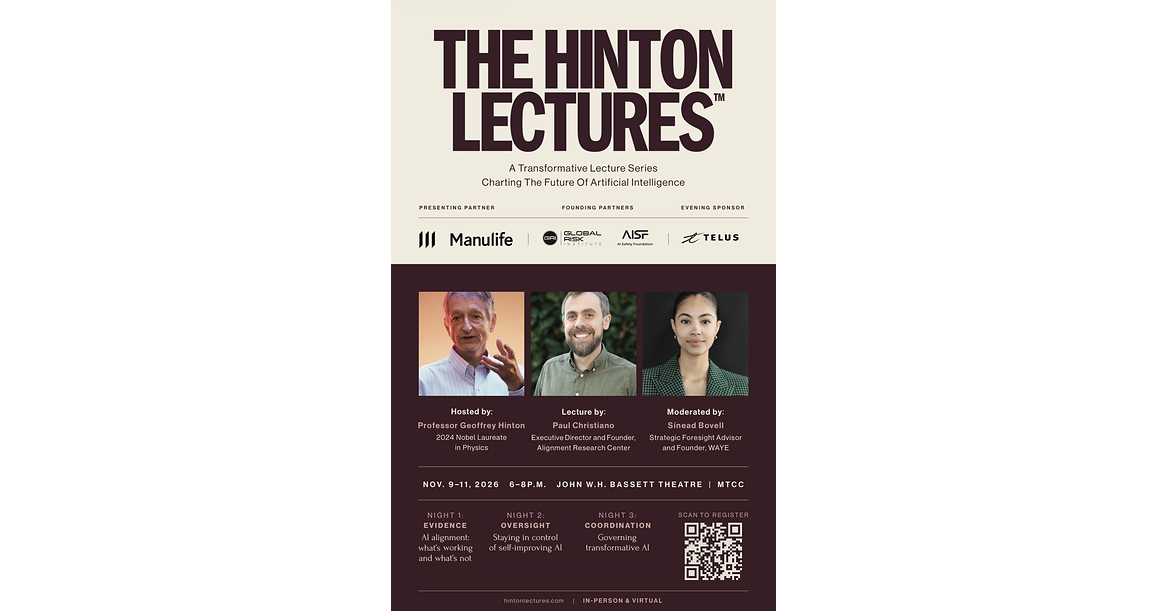
- 9–11NovThe Hinton Lectures on AI safetyToday
- 11NovJules becomes read-onlyToday
- 12NovUpdated Claude usage policy takes effectTomorrow
- 15NovComments close on China's draft tech-export list4days away
- 15NovWorkBuddy and CodeBuddy free period ends4days away
- 18NovWebinar on running a dock with Stretch7days away
- 18NovNvidia invited to brief Congress7days away
- 18NovDots become the default in workspaces7days away
- 19NovKinference demo livestream8days away
- 19NovClaude Data turns on for Enterprise8days away
- 20NovAI Film Award submissions close9days away
- 20NovConductor cloud service shuts down9days away
- 20NovUpdated OpenAI usage policies take effect9days away
- 21NovInaugural edition in Hollywood10days away
- 22Nov'The Challenge Sverige' originally scheduled (now delayed to 2027)11days away
- 29NovDaybreak Blue sessions can be used for training3weeks away
- 30–3Nov–DecContent London 20263weeks away
- 30NovRose d’Or Awards3weeks away
- 30NovGemini 4 Carbon introductory price ends3weeks away
- 1DecHearing on Apple's bid to block testimony3weeks away
- 2–3DecWorkshop on autonomous surgical robots3weeks away
- 4DecAI-made film opens in limited release3weeks away
- 4DecGods Don’t Give Gifts premiere3weeks away
- 4DecSingapore AI Safety Fellowship ends3weeks away
- 31DecHy4 half-price offer ends7weeks away
- 31DecJules shuts down7weeks away
- 1JanFrontier labs must register under the RAISE Act7weeks away
- Later in NovGuided Learning pilot in US schools
- Mid-NovXREAL Aura shipments begin
- DecemberNothing's first AI-native product
- H1 2027Digit 5 early customer access
- Nov–Dec 2026Fort Benning robotaxi pilot
- Later this yearAge checks reach Threads
- 2028R200 systems ready to deploy
- through Feb 2028Language Explorer in Real Talk
- early 2027Firefly always-on agents enter beta





Stories are summarized in plain language; follow the link before quoting a figure. Story images are shown from the publishers' own sites.